The spring 2026 product announcement covered updates to three Atorus products that provide faster paths to results, stronger compliance, more room to grow, and which also combine to form a complete capability system. This is the follow-up for teams who are interested in the technical details.
Here’s a closer look at what’s new and improved in Ageirein, OpenVal®, and Atorus Academy, and what those changes mean for the clinical programmers, biostatisticians, IT teams, and operations leaders day to day.
Ageirein: Open-Source Analytics Infrastructure, Designed for Cohesion
Ageirein’s first release established the functional foundation. This release focuses on unifying the experience across every layer of the platform, from the team configuring the environment to the end user launching an application.
The result is five new capabilities that address the most persistent friction points in clinical analytics environments.
Portal provides a single, secure login to access R, Python, SAS®, and Shiny applications, eliminating juggling across separate tools and environments. All in one place — that’s the goal. It’s a meaningful change that reduces the overhead in your day-to-day work. It sounds obvious, but the productivity difference is not.
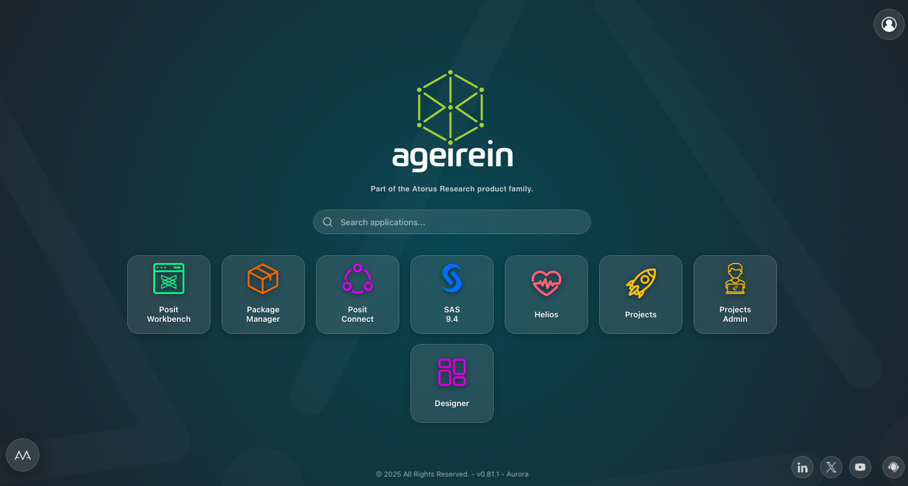
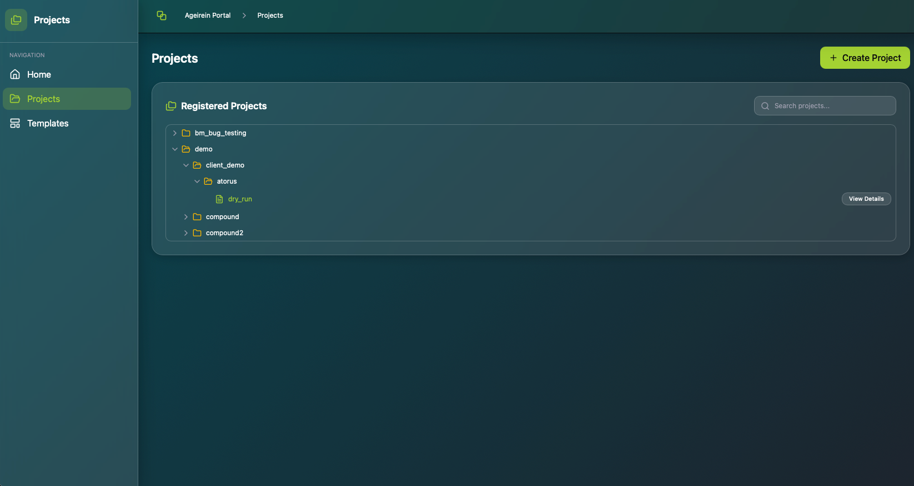
Projects creates secure, structured programming environments in minutes instead of weeks. Each project includes folder structure, permissions, audit trails, and data access configuration from the start. What sets Ageirein apart is how teams can structure data and workflows around the way they actually work — not around the limitations of the platform.
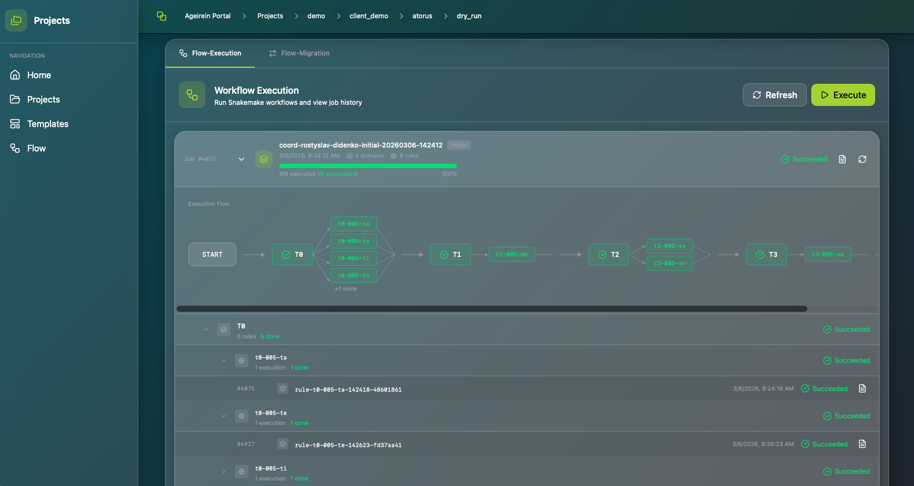
Flow addresses a problem every team with interdependent programs knows well — the manual coordination of what runs when. Flow automates execution order for dependent programs, eliminating sequencing errors and coordination overhead that slow workflows.
Dynamic scaling manages compute resources automatically. Resources scale up when teams are running heavy workloads and down when they’re not, controlling costs without creating bottlenecks. Kubernetes-based infrastructure means this operates on technology clinical analytics organizations are increasingly using as a standard.
AI assistance, powered by AWS Bedrock, operates entirely within Ageirein’s compliance boundary. Clinical data stays within your environment — private, secured, and not leaving your infrastructure.
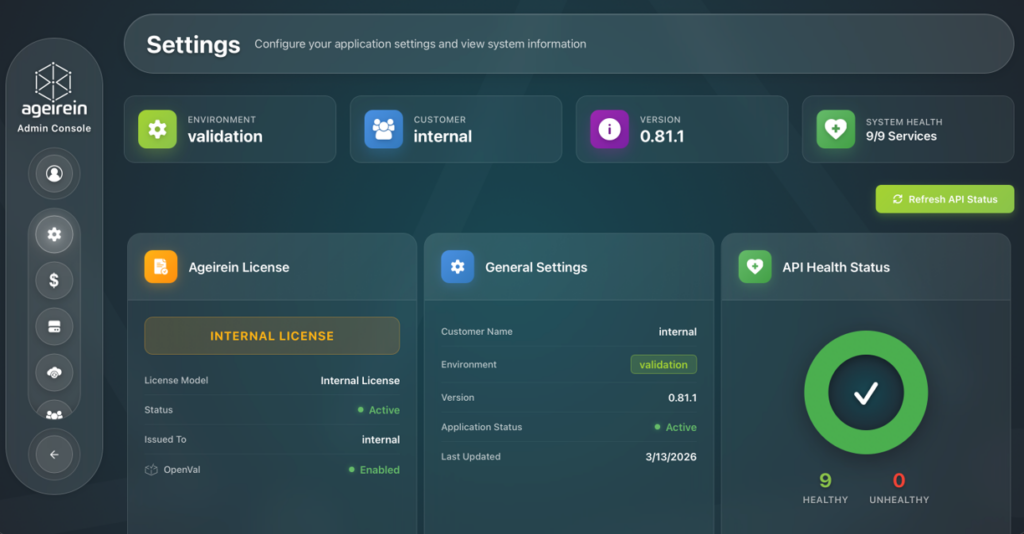
OpenVal: More Than Validated Packages Repository — A Complete Open-Source Analytics Environment
The spring 2026 OpenVal release brings R version 4.5.2 with 580 total validated packages (49 new and 233 updated), but the release notes are only part of the story. Behind those packages sit 907 re-validations across version changes, 15,000+ tests, 89 enterprise installations, and 5 regulatory submissions. That track record is what compliance looks like in practice.
Most validation frameworks operate at the package level: assess risk 🡢 accept or reject 🡢 document the decision. OpenVal does that too, and also goes further. Every package in OpenVal is tested to confirm it produces expected results, not just that it’s been reviewed. That distinction is important when statistical output is going into a submission.
The other distinction is scope. OpenVal delivers a complete, validated R environment, not just a validated package list. Those 580 packages each have their own dependencies, and each operating system introduces additional system dependencies. Atorus manages over 1,000 independent components working together in a controlled, documented environment. That’s what teams get when they deploy OpenVal: It’s a fully integrated, evidence-backed R environment built for reproducible and defensible clinical analytics.
For teams starting from scratch, OpenVal is the fastest path to a stable, audit-ready R environment. For teams with existing validation processes, it makes those processes faster, more consistent, and cost-effective. For teams heading into a submission, it comes with the track record of five regulatory submissions to back it up.
Atorus Academy: R Programming Training Built for Clinical Development
The spring 2026 Atorus Academy release adds new courses in both eLearning and instructor-led formats. Here’s what’s new and why it was built:
SDTM Programming With sdtm.oak and clinify: The industry’s approach to SDTM dataset creation has been evolving alongside the pharmaverse ecosystem. This course covers current tools and methods, not a generic R curriculum with regulatory language layered on top. Available in both coaching and instructor-led formats. Includes a Tables in R update, incorporating clinify and selected FDA standard programs.
Welcome to Ageirein and Welcome to OpenVal: Purpose-built onboarding courses designed to get users productive from day 1. These trainings connect platform capabilities to the clinical analytics workflows users are already running.
Advanced SAS®-to-R Transition Training: The most technically advanced course Atorus Academy has offered. It covers approximately 80% of the R syntax statisticians actively use in clinical research, built by statisticians and programmers who made the SAS®-to-R transition themselves. Customers have reported applying it on live work immediately after training.
All Atorus Academy courses are available in instructor-led and self-paced eLearning formats.
A Complete Open-Source Analytics System
Across Ageirein, OpenVal, and Atorus Academy, this release reflects a consistent technical philosophy: tools that integrate with each other, built by practitioners, and a validated infrastructure built for the demands of clinical development. Teams learn on Atorus Academy, execute on Ageirein, and trust their outputs with OpenVal.
To learn more about the spring 2026 release and how these capabilities fit your needs contact Atorus.
Frequently Asked Questions
What is included in the Atorus spring 2026 major release?
The spring 2026 release includes new Ageirein modules (Portal, Projects, Flow, dynamic scaling, and AI assistance via AWS Bedrock), an updated OpenVal environment (R 4.5.2, 580 validated packages including 49 new and 233 updated), and expanded Atorus Academy training (SDTM Programming With sdtm.oak and clinify, Welcome to Ageirein, Welcome to OpenVal, and advanced SAS®-to-R transition training across three parts).
What is a statistical computing environment (SCE)?
A statistical computing environment is a validated, controlled software infrastructure in which clinical data programming and analysis takes place. In a GxP-compliant SCE, tools, packages, operating system dependencies, and configuration are all documented, tested, and managed to ensure reproducible and defensible outputs. Together, Ageirein and OpenVal provide a fully integrated, validated environment for R-based clinical analytics.
How does OpenVal differ from other R package validation approaches in clinical settings?
Most approaches validate packages through risk-based assessment (reviewing documentation and making an acceptance decision). OpenVal adds functional testing, such that every package is tested to confirm it produces expected results in the actual computational environment. OpenVal also validates the complete environment, managing over 1,000 independent components (packages, dependencies, system libraries) across supported operating systems, rather than a list of individually reviewed packages.
What is Ageirein Portal?
Portal is a new Ageirein module that provides a single, secure login point for users to access R, Python, SAS®, and Shiny applications within the platform. It eliminates credential management across separate tools and creates a consistent entry point for all users regardless of the language or application they’re working in.
How does OpenVal handle R version updates? OpenVal releases are aligned with R version updates, with each release delivering a fully validated environment — not just updated packages. Every new R version goes through the same validation infrastructure: functional testing across all packages, dependency management across operating systems, and full documentation. Teams get a stable, audit-ready environment from day one of each release, without having to manage the validation work themselves.
What Atorus Academy courses support the SAS®-to-R transition?
Atorus Academy’s spring 2026 release includes an advanced SAS®-to-R transition course covering approximately 80% of the R syntax used by statisticians in clinical research. The course is available across three parts in both instructor-led and self-paced formats and is in line with the CAMIS initiative. A foundational SAS®-to-R curriculum is also available.
What is the CAMIS initiative?
CAMIS (Comparing Analysis Method Implementations in Software) is a cross-industry initiative documenting and validating how statistical methods are implemented in R versus SAS®. The alignment of the Atorus Academy’s SAS®-to-R advanced training with CAMIS ensures the curriculum reflects real-world method differences statisticians encounter in clinical research, rather than mere syntax translation.
What is Ageirein Flow, and what problem does it solve?
Flow is an Ageirein module that automates execution order for interdependent programs. Teams with complex clinical programming workflows often manage program dependencies manually — deciding which programs run first, coordinating sequencing across team members, and troubleshooting errors caused by programs executing out of order. Flow handles that coordination automatically, reducing both overhead and the risk of sequencing errors in workflows.